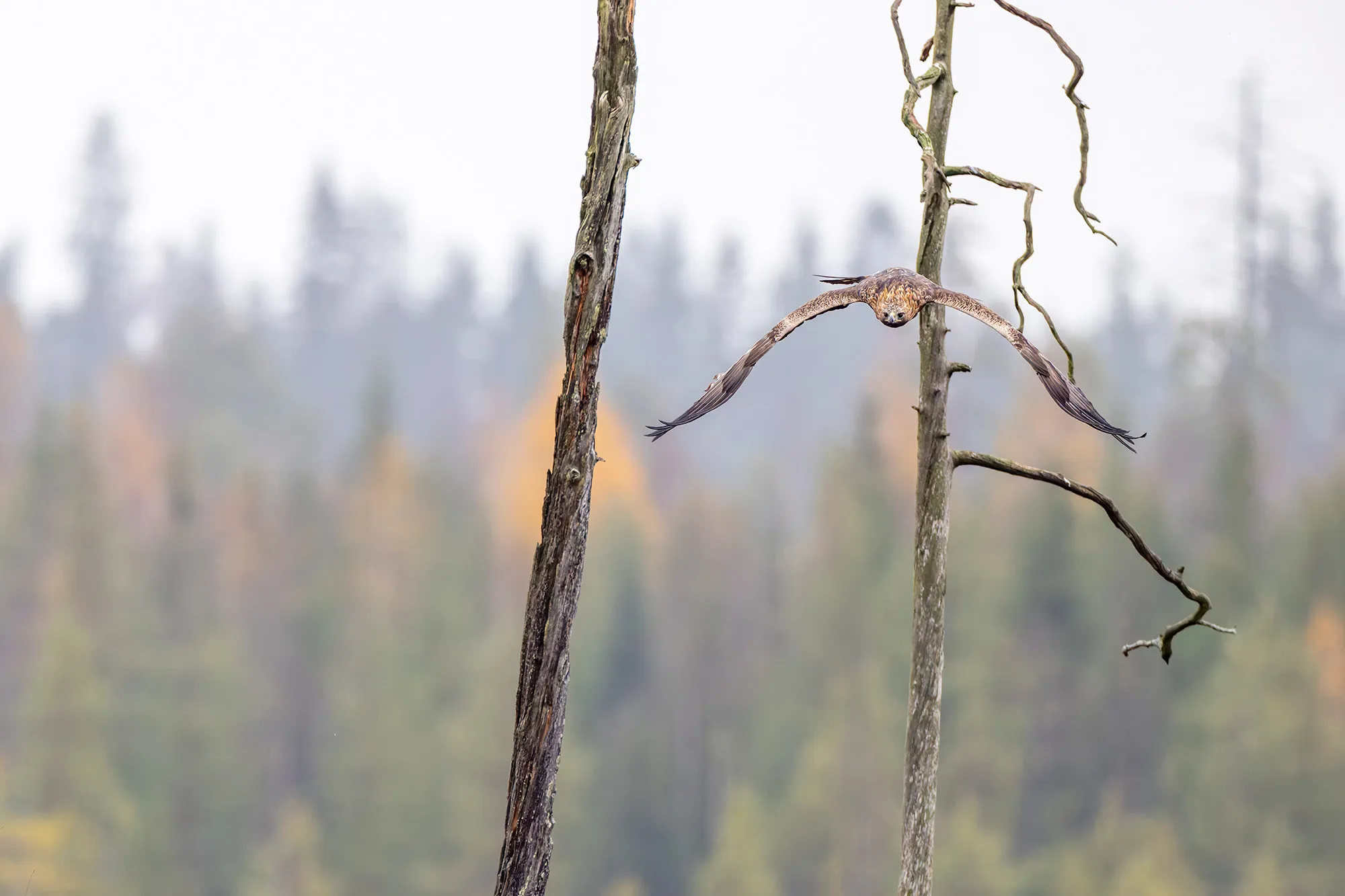
Canon EOS R5 Mark II - experiences of a wildlife photographer

Forewords
The Canon EOS R5 Mk II has a large number of improvements and new features. I won't go into them in detail here. I'll focus on the areas that matter most to me. The user manual for the device is a whopping 1200 pages long, so there's plenty of features. It's a very high-performance hybrid camera, so it's unlikely that any single photographer will use all of its features.
I only shoot RAW files, so I won't discuss jpg features here either.
I process my images with Adobe Lightroom and Photoshop. For noise removal I use Adobe's own Enhance and, in more challenging cases, DxO PureRaw 4 software.

Camera usage areas expanded
I mainly shoot birds and mammals, as well as some landscapes and other natural details. Mostly stills, but also a little video. In the following, I will mostly review the camera's still features based on my own experiences.
Lately, I have often chosen the R3 for moving situations, leaving the R5 as a tool for calmer situations. The main reason for this has been the R3's excellent focusing and focus adjustability. The almost non-existent rolling shutter phenomenon, as well as lower noise and dynamics at high ISO values have also influenced my choice.
The new Canon EOS R5 Mk II has improved in most of these areas. The focus on moving subjects and the related options have improved considerably and the stacked back-illuminated sensor allows for a faster sensor reading than before, reducing the rolling shutter phenomenon. I don't think there has been a radical change in noise when shooting at high ISO values compared to the R5, at least not for the worse.
Continuous burst shooting has been accelerated from 20 to 30 frames per second. This increases the chances of success in fast-paced situations, the downside is the large number of images, 45Mpix RAW files are large. With the R5MkII I switched to using the compressed C-RAW format. With it, the camera's cache does not fill up as quickly because the files are significantly smaller.
The Pre-capture function has finally been added to the 5-series. When enabled, the camera continuously records a half-second buffer (15 frames) when the shutter button is pressed halfway.
This increases the number of images quite a bit, so I hope that Canon adds the ability to adjust the duration of this buffer in future firmware updates.
As of this writing, the R5MkII has received one firmware update (1.0.1). Minor improvements and even new features are sure to be coming in future updates.



Mon-Fri 9-17 and Sat 10-14
INFO

