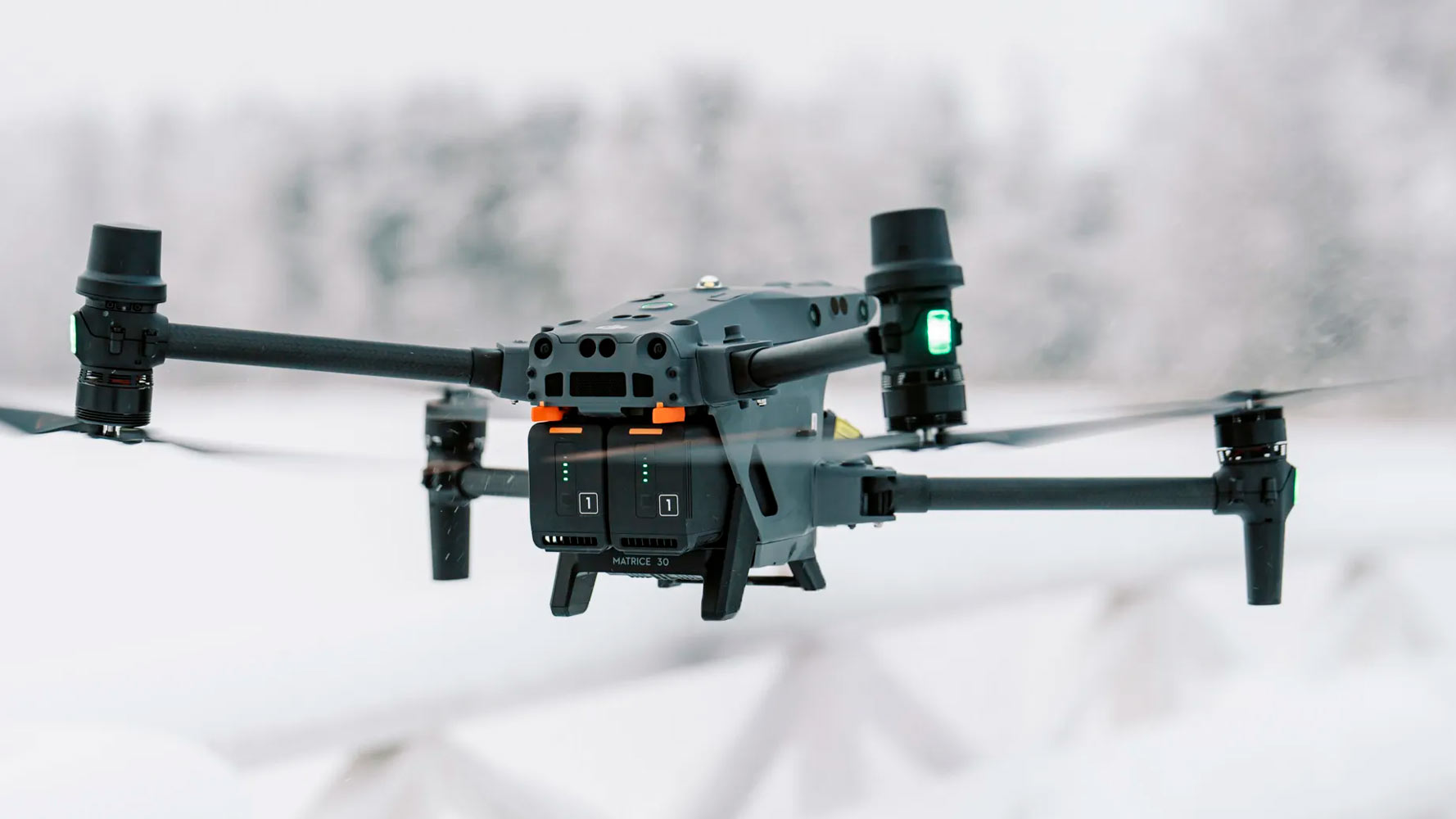
Drone with thermal camera - A versatile tool for professionals

What is a thermal imaging camera?
Thermal cameras present the variation of thermal energy, which is invisible to the human eye, in a visual and understandable way.
Devices can detect thermal energy, or infrared radiation (IR), emitted by buildings, people, and animals, for example. Although the human eye cannot detect this radiation, a camera equipped with infrared technology can.
The operation of an infrared camera is based on a sensor known as a microbolometer. The sensor consists of thousands of tiny heat detectors. which convert infrared radiation into electrical signals. The thermal camera processes these signals and creates a visual image of the temperature distribution in the imaged area, i.e. a thermal image or thermogram.
The image produced by a thermal camera shows how much heat is radiated from an object. The amount of thermal radiation is expressed in colors, with cold temperatures represented by shades of blue, purple, and green. Warm temperatures are expressed in shades of red, orange, and yellow.
Thermal cameras come in various types, including handheld devices and drones equipped with thermal cameras, which we will explore in more detail in this article.

Drone thermal camera



Mon-Fri 9-17 and Sat 10-14
INFO

