Celestron Eyepiece and Filter Kit

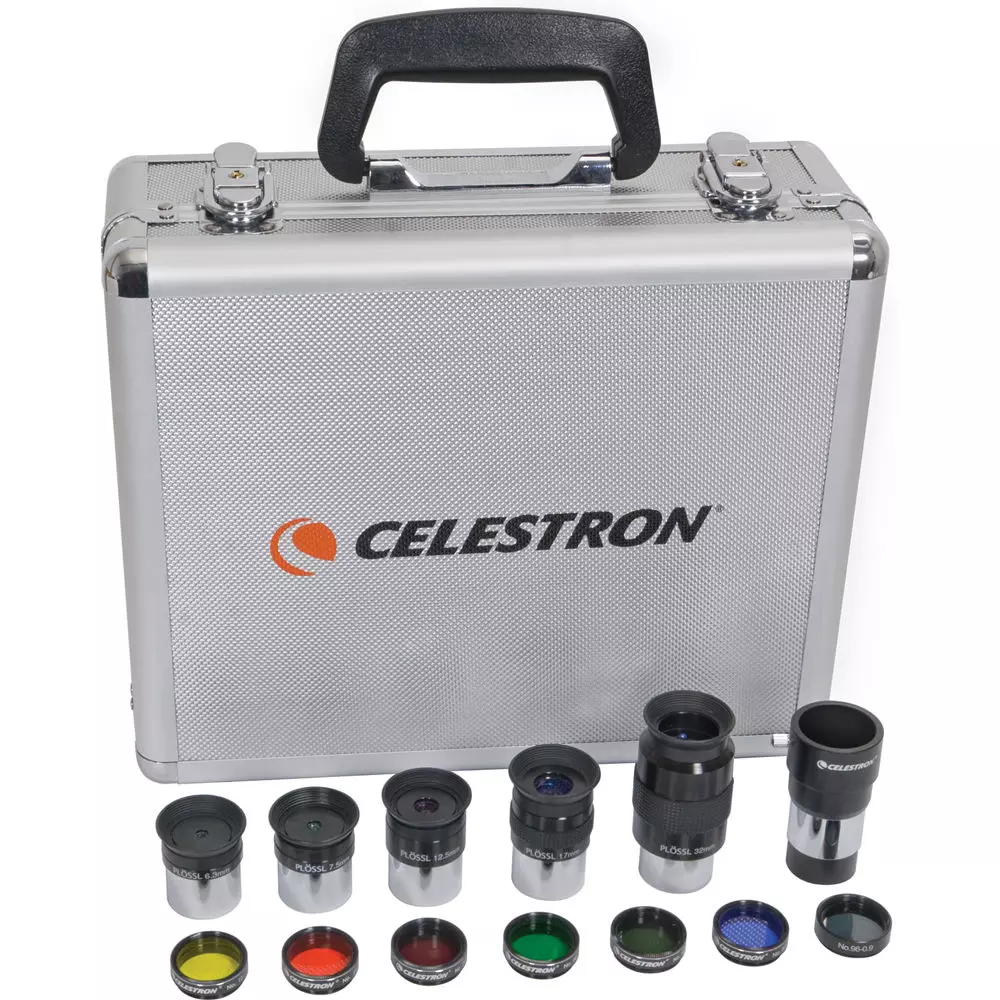
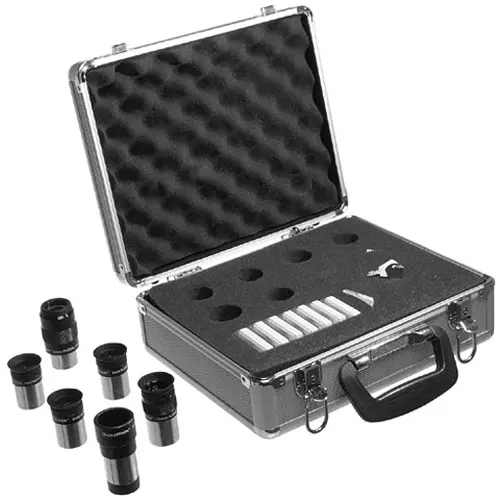

Metal case with 5 high-quality Plosll eyepieces, 2x Barlow lens and a wide range of filters. The right eyepiece for every situation.

Delivery immediately (Varastossa 1 kpl)
Katso yritysasiakkaan maksuvaihtoehdot
Toimituskulut:

30-Day Free Return
Celestron Eyepiece and Filter Kit
A very extensive accessory package for the telescope user. The accessories come in a stylish and durable metal case. The eyepiece mount is a universal 1.25' and these will fit all Celestron telescopes in our range as well as devices from other manufacturers.
The portfolio includes the following products:
- 32mm Plossl eyepiece - 1.25'
- 17mm Plossl eyepiece - 1.25'
- 13mm Plossl eyepiece - 1.25'
- 8mm Plossl eyepiece - 1.25'
- 6mm Plossl eyepiece - 1.25'
- 2x Barlow lens with thread - 1.25'
- #80A blue filter - 1.25'
- #58A green filter - 1.25'
- #56B light green filter - 1.25'
- #25 red filter - 1.25'
- #21 orange filter - 1.25'
- #12 yellow filter - 1.25'
- Moon filter - 1.25'
- Microfiber cloth
Eyepieces
The included eyepieces can be used with all 1.25 inch focusing telescopes. All eyepieces are high quality Plosll type eyepieces. The field of view is 52 degrees, the lens surfaces are multi-coated and there are four lens elements in the eyepiece.
The 32mm eyepiece provides the lowest magnification, suitable for searching for targets and observing larger objects such as sieves.
The 17mm and 13mm eyepieces provide a nice mid-range magnification for most telescopes, while the 8mm and 6mm eyepieces provide a higher magnification for viewing planets with excellent clarity. The maximum magnification you can use also depends on the telescope and the conditions. If the viewing conditions, or so-called Seeing, are good, you can get great views of Saturn's rings with these 6mm and 8mm eyepieces.
The good thing about the eyepiece set is the number of options, open the case and attach a new eyepiece to the telescope and you can see new details or get a wider and easier to see view. In principle, you can get the magnifications that are available with this set with the help of the 10pcs Barlow lens that is included.
2x Barlow lens
Add a Barlow lens between the eyepiece and the telescope to double the magnification of any 1.25' eyepiece. This means that the 13mm eyepiece included in this package doubles in power, making it equivalent to a 6.5mm eyepiece, and a 6mm eyepiece will give you the same magnification as a 3mm eyepiece.
The advantage of the Barlow eyepiece is also the increased viewing distance. The 13mm eyepiece + Barlow mentioned in the example gives approximately the same magnification as the 6mm eyepiece, but viewing is better with glasses!
Any other 1.25 eyepiece works on the same principle, so there are many possibilities. However, remember that high magnification does not always produce a sharp and clear image, especially in bad weather. Test and experiment to find the best settings for you and your telescope. The Barlow lens has threads that can also be attached to a SLR camera. You will need a camera-specific T2 adapter.
Filters
Colored filters can be used to highlight the surface features of a planet or its cloud formations. Both planetary filters, as well as the lunar filter, can be used with any 1.25 inch eyepiece with the correct filter thread, making them very versatile. Screw the filter onto your chosen eyepiece and slide it into the viewfinder.
#80A is a blue-toned filter that enhances contrast in places like Jupiter's cloud belts and Saturn's polar ice caps. It can also be used to improve contrast when viewing the Moon, provided that color distortion is not a problem.
#25 is a deep red filter and a good choice when you want to focus on the polar ice caps of Mars. The filter also works when viewing Jupiter. The red #25 filter filters quite a bit of light as it enters the telescope's optics, so it works best for bright objects in large aperture telescopes.
The #58 green filter increases contrast in the lightest parts of Jupiter, highlights the polar region of Saturn.
#56 light green is suitable for observing the moon and viewing the polar regions of Mars.
#21 highlights, for example, Jupiter's Great Red Spot. Jupiter's Great Red Spot is a persistent giant storm on the surface of Jupiter.
A lunar filter is often the first accessory an amateur astronomer buys, and for good reason! It helps to limit the light reflected by the Moon and make details more visible. It is also a good idea to view Venus with a lunar filter - it helps to see the phases of the planet better.
The metal case is durable and padded on the inside. This way, the delicate contents of the case are exposed to as little impact as possible. Store your accessories in their own place when you're not using them, and they'll stay as good as new for a long time.
Osta myös
Tarjous
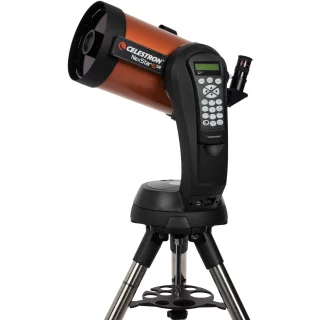
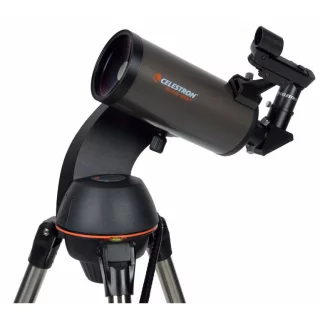
Celestron Nexstar 90 SLT astronomical telescope
Delivery immediately
Tutustu myös tähän vaihtoehtoon
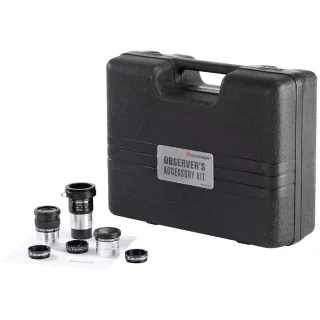
Celestron Observer's Accessory Kit for telescopes
Delivery immediately
Tutustu myös tähän vaihtoehtoon
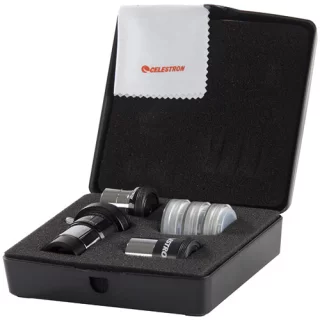
Celestron Astromaster Accessory Kit for telescope
Delivery immediately
Tutustu myös tähän vaihtoehtoon
DJI Air 3S Fly More Combo - drone with accessories and on-screen controller
Delivery immediately
Katsottu usein yhdessä
200€ Cashback
OM System M.Zuiko Digital ED 40-150mm f/2.8 PRO lens
Shipping 7-14 days
Katsottu usein yhdessä
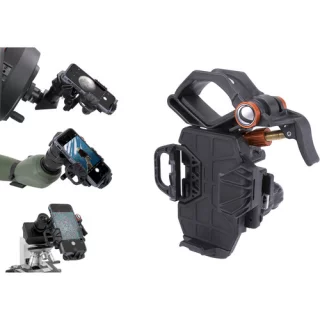
Celestron NexYZ 3-Axis Universal Smartphone Adapter - Phonescoping sovite
Delivery immediately
Tutustu myös tähän vaihtoehtoon
Arvostelujen yhteenveto
15.12.2020
Anonyymi
Asiallinen laadukkaan oloinen sarja. Hyvä säilytyslaukku.
Lue lisää
Kysy tuotteesta

Avoinna myymälän aukioloaikoina
ma-pe 9-17 ja la 10-14
ma-pe 9-17 ja la 10-14
Vastaamme asiakaspalvelun viesteihin viimeistään 24 h kuluessa
Porrassalmenkatu 21 50100 Mikkeli


Muuta evästeasetuksia