
Photokina 2018 - Camera shop trade show report
Update: Photokina 2022 has been cancelled and it seems that this 2018 event was the last one. In this article, you can follow the journey of the camera industry. What the last fair looked like and where the event that has been held for over 70 years ended.
Photokina is the world's largest photography trade fair. Photokina is held in Cologne's gigantic exhibition halls every two years in September. We've put together a small report on the new products we saw - now that some of the products are already arriving on our store shelves for sale. In addition to cameras, there's everything related to photos, large printers, frames, 360 cameras and VR devices, video cameras and LED lights. So the scale is very wide.
The most publicity was received by mirrorless full-frame system cameras from various manufacturers. Following Sony's lead, announcements were made by major manufacturers Canon, Nikon and Panasonic, and these new products were also available to a wider audience for the first time.


The biggest surprise came from Panasonic, even the internet rumor sites had almost no advance information about the new camera system. Panasonic, Leica and Sigma announced a collaboration and a common lens mount. Panasonic will adopt Leica's L-mount for full-frame cameras, and Sigma will also start making lenses with this mount.
In principle, Sigma will start manufacturing all Art series lenses from the Sports series with this mount, so there will be dozens of lenses available for the Panasonic body as soon as the first bodies go on sale.

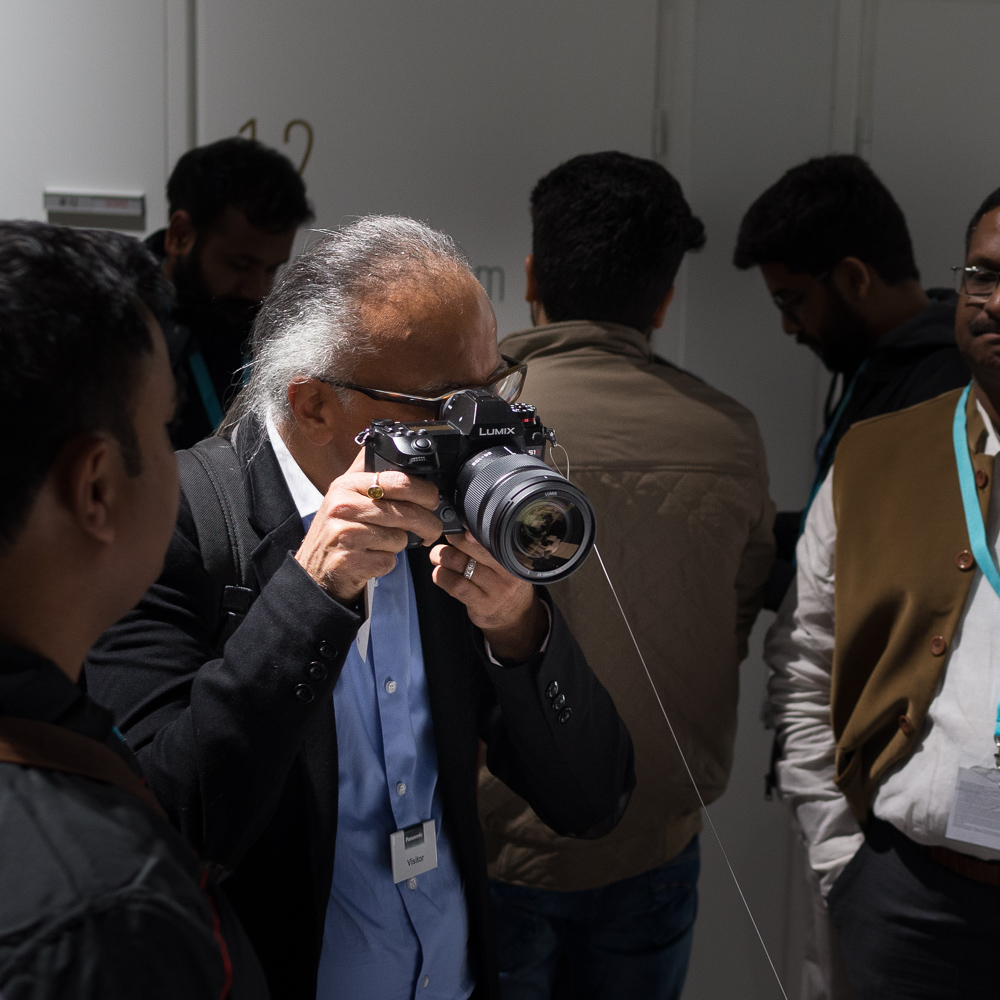
The camera we tested was a wooden model without electronics, and the finishing was also partly unfinished, but it immediately became clear that mirrorless does not mean small size. The Panasonic body was a fair size for a mirrorless system (in the style of the Canon EOS 5D IV) and the size of the lenses also shows that the search is for top-class image quality and not a system that fits in a handbag.
The body was shown with a 24-105mm f4, 50mm f1.4 and a 70-200mm telephoto zoom whose maximum aperture was not revealed. Judging by the size, we'd guess that the maximum aperture is closer to four.

The Panasonic S1 and S1R are expected to start shipping in early 2019. The S1 is a 24-megapixel body and the S1R is a higher resolution 47-megapixel body. The division is likely to be somewhat similar to Sony, with lots of megapixels for photographers and more reasonable megapixels and top-notch video capabilities for hybrid photographers (those who shoot stills and video).
Naturally, Leica lenses will also work with Panasonic bodies. Panasonic has also stated that it is committed to the smaller sensor Micro Four Thirds system.

Next up Nikon


Nikon's answer to mirrorless is the new Z series. The first three lenses, an adapter, and two bodies were released. The images here show the 24-megapixel Nikon Z6, which is better suited for video use.
The pictures immediately show what the manufacturers are aiming for with the new lens mounts and mirrorless. If nothing else, at least the sensor is extremely easy to clean in this new Nikon, the bayonet actually fills the entire height of the body and the lens comes very close to the sensor level.

The apertures of these new bayonets immediately became a millimeter race, now Sony has the smallest and Nikon the largest aperture. The future will show how this is reflected, if at all, in the quality of the systems' lenses. Now Nikon has not released a lens faster than F1.8 except for a paper announcement of the upcoming manual focus Noct-Nikkor F0.95 lens.

The new EOS R was the main attraction at Canon's large stand. There was a large pile of bodies and RF lenses to try out. Now the camera is already on store shelves and you can try the body yourself at the Mikkeli store as well.


The dimly lit exhibition environment served as a good testing ground, especially with the new RF 50mm F1.2 lens, the camera focused into the darkest corners of the hall without any problems. The manufacturer's products were on display in a very wide range, the new 400mm and 600mm super telephoto lenses had been raised to the balcony and it was good to play nature photographer and take aim at the visitors. The best thing about Canon's stand was how all the very technical features were explained in the form of a picture or demonstration. I could easily see with my own eyes what the technical data listed on the spec sheets really mean and what kind of photo or video they enable.

A cross-section of the Canon EF 400mm F2.8 II and III lenses. This image shows nicely how the lens elements are located at the back of the lens. The handling is significantly better with the new center of gravity and the weight is also about a kilo less than the old version.

Canon's automatic sensor cleaning machine, a robotic arm takes the cleaning pads and the cleanliness of the sensor is apparently ensured using machine vision. A very handy machine.

Many camera manufacturers had free cleaning services at their booths, and you could leave your bodies and lenses for inspection and get them back meticulously cleaned.

The stand also had a fun display of Canon ambassador photographer equipment. Here is the bird photography equipment of Finnish Markus Varesvuo. Luckily, Markus got his mittens and hat back before the winter frosts arrived.

Rumor has it that Canon and Nikon will release their escalator models next year.

New product from Samyang. 10mm F3.5 wide-angle lens for full-frame. And this is not a fisheye! So it promises a very wide-angle focal length without distortion. Compared to full-frame wide-angle zooms, this lens is very compact, as you can see in the picture.

Is the Samyang 10mm suitable for example as a companion to this Slik affordable and very smart tracking motor for shooting the starry sky? The Slik Astra ECH-630 Astro is a top device, the device is mounted on a tripod, aimed at the North Star, the camera is closed and the device is turned on. In this way, you can make exposures of the starry sky for several minutes and the stars remain sharp because the camera follows the rotating movement of the Earth.
The Slik booth's camera choice was interesting, the film's reciprocating effect can extend exposure times to very long. It's worth taking snacks with you on your photoshoot.


Zhiyun-Tech showed several new gimbal stabilizers at the fair. The latest version of Crane is the Crane 3 Lab, which has been completely redesigned, thanks to the handle the center of gravity is not at the end of the arm and the very sturdy device is quick to move and easy to carry. The load capacity is a whopping 4.5kg, meaning the device can support even a heavier system camera and lens.
The handle on the bottom also functions as a tripod. Thanks to the new design, the horizontal axis no longer covers the rear screen, and the viewfinder image can also be transferred to the phone wirelessly in HD quality, and the gimbal's movements can also be controlled via the phone.
The Crane 3 Lab supports two controllable motors, in addition to different follow focus, the device can also adjust the lens zoom. All in all, it's a great device, and the price is probably very affordable considering the features.

Another new product for travel photographers has been announced. The Zhiyun-Tech Weebill Lab is a more compact stabilizer for mirrorless cameras based on the same clever design. It has a load capacity of 3kg and fits into a very compact carrying case, making it perfect for backpacking trips.
The picture clearly shows how the center of gravity is easier to hold than in straight bar-style devices. This is easy to use for long periods of time, and what's more, the battery life is about 10 hours.

Sony's new products, the 400mm F2.8 G Master and the 24mm F1.4 G master. Both are very light in their class, the Sony is probably the lightest 400mm F2.8 super telephoto available. The 24mm wide angle is also a very smart size.
In the background, there are Sony candies and secret notes. The topic could be Sony A7S III specs or perhaps upcoming promotions.

What does the 12390e look like in one hand? These modern super telephotos are surprisingly light, easy to carry and move even in difficult conditions. They also respond well to fast movements thanks to the reduced mass and the center of gravity at the tripod collar.


The texts were in German so we have to guess what this is. Probably a memory card terrarium somewhere, where the card is offered a relaxing stay in warm conditions and is given plenty of water and exercise equipment.

FujiFilm X-T3 photographed with FujiFilm GFX 50R medium format digital camera.

FujiFilm GFX 50R photographed with FujiFilm X-T3 camera.


And both side by side. The sensor size and price of the cameras are very different, but the usability is guaranteed Fuji quality in both. The controls are conveniently displayed in the same way on both. The GFX 50R is basically a very straight Texas Leica version of the X-Pro2.
Even a quick test left a good first impression, it may be that soon these cameras will also be sold outside the Helsinki Ring Road.


Fuji's stand also had a large area full of works by photographers from Magnum Photos. This was a big plus for Fuji. The photos were also definitely not the traditional pretty little travel and portraits, but rather the more ugly expressions of Antoine D'Agata, for example.


A new product from Magmod, a manufacturer of flash accessories. One or two handheld flashes can be quickly attached to the reflector with a magnet. Is this a suitable alternative to large studio lights for gig use? The set is quick to assemble and also comes with a transport bag. Like other Magmod products, it is a very high-quality product.


Nisin's gradual ND disc filter and holder... for your cell phone. This was perhaps a surprising novelty, but otherwise it seems that filters are used too little in landscape photography these days. Lightroom is handy, but with a good set of filters you can already do a lot during the shooting phase.


Disc filters are handy for slower-paced shooting, the same high-quality set works for all lenses, and traditional screw-on filters may not be suitable for wide-angle lenses due to the curved front lens.

Next up is one of Kamerasik's favorite brands: Peak Design


All products were on display, including shoulder bags, Slide straps and Capture series products. In addition, the new Travel series backpacks and all the camera sections in the series and slightly more exotic accessories such as shoe bags were available for inspection and assembly.
The most interesting thing, however, was Peak Design's new project, which I can't write anything about at this point, but next year we'll see a new surprise conquest! (Edit. and it was the Peak Design Travel Tripod, which has now been announced)

From the challenger's stand, we made our way to the traditional backpack manufacturer, Lowepro, which displayed good old models updated and a couple of new ones.


Here the black Freeline backpack is a bit worn and the straps are dangling but the backpack itself is nice and cleverly designed. The camera section has to be removed and can be folded into a small pile if the backpack does not need to be divided into sections for cameras and lenses.
While looking at this backpack, we pointed out to the Lowepro designer who was there that the new design was a bit reminiscent of Peak Design. We heard the story of how Peak Design had met Lowepro designers back in the days of the original Slide and Capture and there was talk of designing backpacks. However, Peak Design decided to make the Everyday bags and backpacks themselves. There was no bitterness in the story, however, as both companies value quality products and good design.


This is not your grandfather's heirloom, but a full-frame digital rangefinder camera with an M-mount. This demo piece worked and blossomed.


And the lens is a 35mm F1 (yes, F1) Made in Russia Zenitar. Maybe you'll find these at flea markets and basements in 2089.
In addition to manufacturers, Photokina features many small players and specialized companies. People often talk about the importance of trade fairs like Photokina, IFA or the domestic Kuva & Kamera in this day and age, when you can get very comprehensive information and experiences about new products right from the internet.
However, it has its own charm to be able to get up close and personal with the latest innovations, and in professional circles, there are many meetings during the fairs, and it's easy to see the people behind the scenes of the entire industry. And you rarely get to shoot with, for example, a Sigma 200-500mm lens.

Okay, there were a lot of electronic viewfinders and megapixels here, but where are the real cameras?


Then, from the dim little stalls downstairs, I get a bucket of spare parts for my mini lab and the trip home.


This is likely to be the last Photokina event traditionally held in the autumn, aimed at both consumers and professionals. The event will probably be moved to the spring and may be aimed mainly at Central European sellers and companies. Which is also a shame, especially if the set-ups on display, such as the giant lizard made of colorful artificial flowers hanging from the ceiling, are replaced by backroom PowerPoint meetings.