
Telescope selection guide - tips and instructions
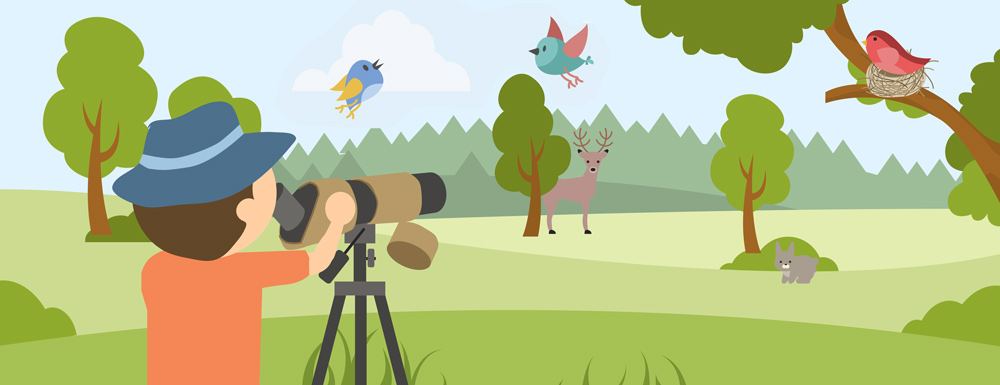
The telescope is suitable for birdwatching, nature walks, and even for use in the backyard by the whole family.
Choosing a telescope is a matter of compromise - for example, if you want the highest possible magnification, you will have to sacrifice a little in brightness and field of view, or if I want the brightest possible tube, you will have to settle for a larger and heavier telescope.
Most people who buy telescopes want to observe nature, and most of them focus their observation on birds. While binoculars bring the subject close, telescopes allow you to look directly into the bird's eyes, and allow you to see details for species identification.
In a nutshell!
- The most important parts of the telescope are the body, or lens module, the eyepiece, and a sturdy stand with a video head.
- Choose a telescope depending on whether you move around a lot or mainly watch from a stationary position, e.g. in a birdwatching tower.
- Consider whether you want light power at the expense of portability, or are you looking for a travel tube where lightness and easy portability are the number one priority.
- If you want the ability to do digital/phonescoping, consider a brighter telescope.
- Also invest in a tripod, as a stable image is much more pleasant to watch.
To make your choice easier, we have put together proven packages in our online store.


Straight or angled
Telescopes are sold in two different construction options - straight and angled. This refers to the position in which the eyepiece is attached to the telescope body. In a straight model, the eyepiece is in the same straight line as the telescope body, and in an angled model, the eyepiece is, as the name suggests, at an angle, usually 45 degrees compared to the telescope body.
The advantages of an angled telescope are that it allows for a more relaxed viewing position. In addition, the tripod can be set lower, making it easier for people of different heights to switch viewing positions. An angled telescope also makes it easier to view birds flying in the sky.
A straight-line telescope is advantageous when viewing objects below your viewing position, such as if you are on a slope and looking down the slope. The straight design also provides easier viewing if you want to mount the telescope to a car window with a suitable mount for viewing.
| Angular | Straight model | |
| Pros: | + More comfortable to watch for longer periods of time | + Slightly easier to find and track a moving object + Direct model more comfortable if viewing takes place in a booth or car + Easier to observe objects that are below the viewing level |
| Cons: | - For the unaccustomed, it is a little more difficult to follow the target at first. | - May be uncomfortable for longer viewings |
Magnification
Unlike binoculars, choosing the magnification of a telescope is not as critical, as the highest quality telescopes have interchangeable eyepieces. And those with a fixed eyepiece include a zoom, which provides flexibility in viewing (e.g. Kowa TSN-501 ). Telescopes with interchangeable eyepieces allow you to purchase eyepieces for different situations and purposes as needed.
Binoculars are essentially compact telescopes designed primarily for terrestrial viewing, and are used in situations that require higher magnification than binoculars. Magnification usually ranges between 15x and 250x, but most enthusiasts prefer 20-30x magnification.
The reason why you don't want the maximum possible magnification is because:
- luminous intensity decreases as magnification increases
- higher magnification reduces the field of view
- the higher the magnification, the more likely the image will show wobble
Fixed and zoom eyepieces
Fixed focal length eyepieces offer slightly better optical quality than zoom eyepieces, but this comes at the expense of flexibility.
Zoom eyepieces, on the other hand, are the choice of almost every birdwatcher. Zooming allows you to zoom out to find your subject, then zoom in to see more of the subject's details.
Telescope front lens diameter
To get the brightest possible image, you need a telescope that gathers a lot of light. To do this, the telescope must have a large front lens.
The size of the front lenses of a telescope generally ranges from 50mm to 90mm, and within this range the most common sizes are 60mm and 80mm. For example, Swarovski also offers a large and bright 115mm telescope.
The problem with a large front lens is that it increases the size, weight, and cost of the telescope. So the brightness of a telescope is something where you have to make compromises depending on what features you value.
If you are a birdwatcher who moves around a lot, or are otherwise looking for a telescope where lightness and easy portability are top priorities, we recommend, for example, 60mm and 80mm telescopes.
If, on the other hand, you mainly observe with a telescope from a stationary bird's eye view, or if you value brightness and sharpness more than portability, or if you want to use the option for digiscoping, then we recommend telescopes with a higher brightness.
Field of vision
As we explained in our binoculars guide , the field of view is basically the width of the image you see through your viewing device. This also applies to telescopes. For birdwatching binoculars, a very wide field of view is ideal, as it makes it easier to spot fast-moving and sideways objects. However, in order to achieve the widest possible field of view, you usually have to sacrifice magnification.
This is also why the most common magnification in the world of binoculars is 8x, even though there are stronger magnifications available. In the world of telescopes, the ubiquitous magnification popular is in the 20-30x range.
Eyepieces are available for telescopes that offer high magnification while also focusing on the width of their field of view. Such eyepieces are marked with the letters 'W' or 'Wide'.
Focusing
For example, the ideal telescope for bird watching is one that focuses quickly from near to far, and in addition offers fine focus adjustment to achieve the sharpest possible image.
The two most common ways to focus are either a large focusing ring around the telescope body (e.g. Swarovski telescopes), or a smaller separate focusing knob on top of the telescope (e.g. Nikon or Kowa).
A Swarovski-style, collar-shaped focusing ring embedded in the telescope body is usually a faster focusing method, but can be a bit more difficult to fine-tune. Whereas a separate focusing knob on the top of the telescope usually offers slightly slower focusing from near to far, but allows for more precise focusing.
Some Kowa telescopes have a dual-action focus knob, meaning that the focus is adjusted using two focus screws. The larger one is for coarse (and fast) focus, and the smaller one is for fine-tuning the focus.
Tripod + tripod head
The tripod plays a significant role in the stability of the telescope and viewing comfort. The tripod must be sturdy enough so that small gusts of wind or vibrations, caused for example by handling the telescope or the movements of fellow observers in the birdwatching tower, do not affect the stability of the viewed image.
In addition, the correct height of the stand and the tripod head attached to the stand affect overall viewing and usage comfort.
Choose the right height: The tripod should be chosen depending on whether you are using a straight or angled telescope, and the height of the viewer or viewers. When using a straight telescope, the tripod should be at least eye level, so you don't have to bend or bend your knees when viewing. A lower tripod is sufficient for an angled telescope, as the 45-degree eyepiece requires you to tilt your head downwards when viewing.
When choosing a tripod, we recommend choosing a model that is tall enough that you don't have to raise the legs and center tube of the tripod to the maximum, as this will not provide maximum support. Support is improved when you can afford to shorten the legs and center tube.
Choose the right tripod head: The most popular option for a telescope is a video head, which allows you to follow your subject smoothly in all directions. The telescope is turned using the video head handle, so you don't have to touch the telescope itself.
Aluminum or carbon fiber: Carbon fiber tripods are lighter than aluminum, but they cost more. If you move around a lot with your tripod, the extra investment is often worth it. Carbon fiber also absorbs vibrations faster than aluminum, but if it's windy, carbon fiber won't be as useful.
Another benefit of carbon fiber is that it does not absorb heat or cold, so a carbon fiber stand is more comfortable to handle.


Saving targets with a telescope
When observing nature, you may also want to record what you see, for example to document a sighting. Traditionally, recording has been done with a sturdy telephoto lens, but at some point, carrying a lot of equipment with you starts to weigh on your shoulders.
Portable binoculars bring the object you are viewing 8 or 10 times closer, and a telescope magnifies the object 20-60 times, so why not utilize these tools as optics when recording observations.
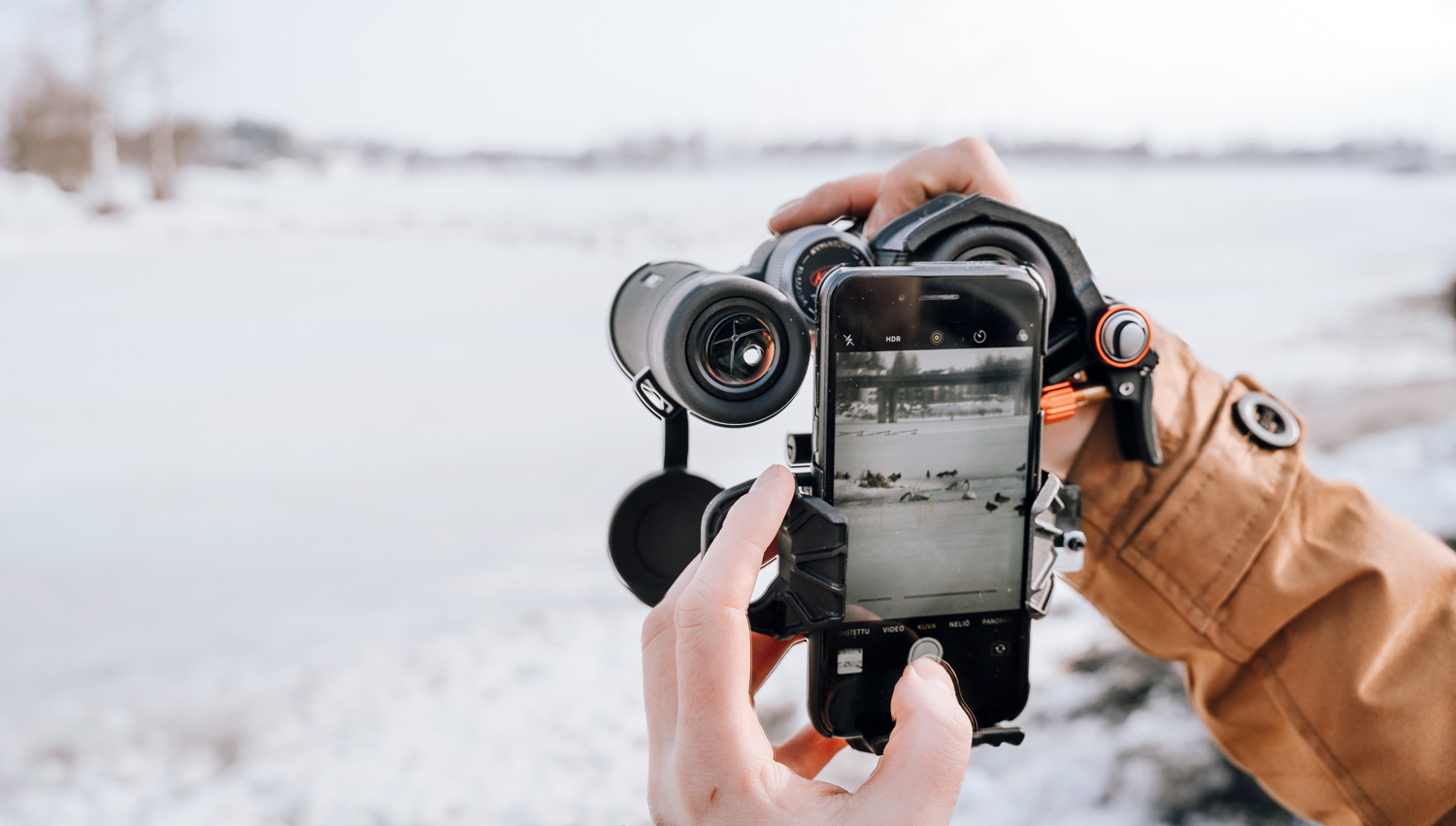
This can be done with suitable adapters, and even with the help of your smartphone.
Read more in our article about digiscoping setups!
Click here to access our popular binoculars guide!